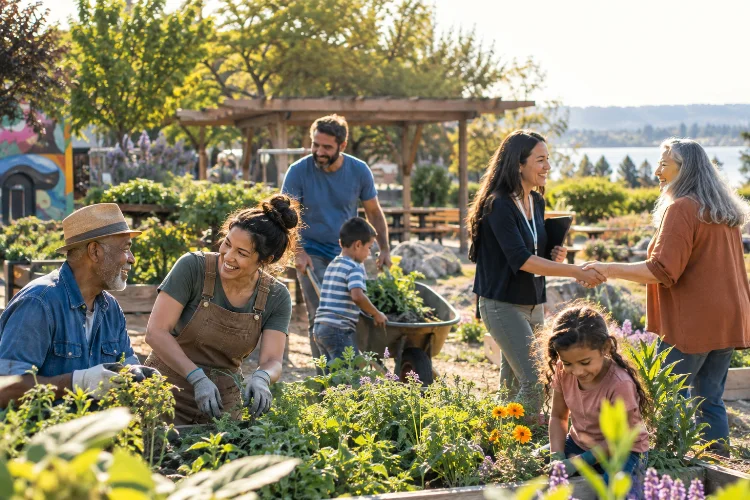
Imagine living in a neighborhood where you recognize familiar faces, know who to call when you need help, and feel comfortable joining local activities. Now compare that with living somewhere surrounded by people but barely knowing anyone.
The buildings might look similar, but the experience of community would feel completely different.
This is one reason why social connections matter for healthy communities. Relationships between neighbors, families, coworkers, volunteers, teachers, local organizations, and other community members create an invisible network that influences how people live together.
These connections can provide emotional support, practical help, information, friendship, trust, and a sense of belonging. They can also make communities better prepared to solve problems and respond to difficult situations.
Social connection is increasingly recognized as more than a personal lifestyle issue.
Organizations such as the World Health Organization and CDC describe it as an important part of health and well-being, making stronger relationships relevant not only to individuals but to entire communities.
What Do We Mean by Social Connection?
Social connection is not simply about having lots of people around you.
The World Health Organization describes it through several dimensions, including the number and types of relationships people have, the support exchanged through those relationships, and the quality of the interactions themselves.
That distinction matters.
Someone might have hundreds of social media contacts but feel that nobody truly knows them. Another person may have only a handful of close relationships yet feel strongly supported.
Healthy social networks can include family members, friends, neighbors, coworkers, classmates, community leaders, sports teammates, volunteers, and people who share common interests.
What matters most is whether those connections offer meaningful interaction, trust, care, and opportunities for participation.
Strong Relationships Support Physical and Mental Health
We usually think about healthy communities in terms of hospitals, clean environments, nutritious food, exercise, or safe streets.
Relationships deserve a place in that conversation too.
The CDC reports that supportive social connections are associated with better health and can help people manage stress, anxiety, and depression. They may also support healthier behaviors, including physical activity and better sleep.
The relationship between connection and health has also appeared in large research reviews.
One influential meta-analysis involving 148 studies and more than 300,000 participants found that people with stronger social relationships had a higher likelihood of survival during study follow-up.
This does not mean friendship is a magic medicine. Health is influenced by many factors.
Instead, it shows that human relationships are one important part of the broader social enviroment that affects well-being.
Social Connections Create a Sense of Belonging
A healthy community is not simply a place where people live close together. People also need to feel that they have a place within it.
Belonging develops when individuals feel accepted, noticed, valued, and able to participate.
Consider a new resident arriving in a neigborhood. If nobody speaks to them, community life may remain distant even after several years.
If neighbors introduce themselves, invite them to activities, and share useful information, the newcomer can begin developing a sense of connection surprisingly quickly.
Belonging can matter in schools, workplaces, religious communities, sports clubs, volunteer groups, and digital communities as well.
The U.S. Surgeon General’s social connection resources emphasize that participation in social and community groups can support belonging, meaning, and purpose.
Sometimes a simple invitation is what turns someone from an observer into a participant.
Connection Builds Trust Between Community Members
Healthy communities depend heavily on trust.
People need some confidence that others will cooperate, behave fairly, share useful information, and offer assistance when necessary.
Trust rarely appears overnight. It grows through repeated interaction.
When neighbors regularly talk, parents meet through schools, residents volunteer together, or people participate in local events, they gradually learn more about one another.
Those small interactions can make future cooperation easier.
Imagine two streets facing the same local problem, such as repeated flooding. On one street, residents barely know each other. On the other, people already communicate regularly.
The second group may find it easier to exchange warnings, check on vulnerable neighbors, share equipment, organize cleanups, and communicate with local authorities.
The CDC notes that supportive connections can strengthen community trust and resilience.
Connected Communities Can Be More Resilient
Community resilience is the ability to prepare for, respond to, and recover from difficulties.
Those difficulties might include natural disasters, economic problems, disease outbreaks, power failures, or smaller local emergencies.
Formal services remain essential during these situations. However, informal relationships can provide another layer of support.
A neighbor may check on an older resident during extreme weather. Friends may share transportation after an emergency. Local organizations may coordinate food or temporary assistance. Parents may help one another with childcare.
WHO reports that stronger social ties can contribute to safer and more resilient communities, including when communities face disasters.
In other words, relationships become a form of community infrastructure.
Roads and buildings matter, but so do networks of people who know how to reach and support one another.
Social Isolation Can Affect the Whole Community
The opposite side of connection is social disconnection.
Loneliness describes the distress someone may experience when their relationships do not match the level of connection they want or need. Social isolation refers more objectively to having too few relationships or interactions.
These issues are widespread.
WHO’s 2025 report on social connection estimated that about one in six people globally experience loneliness. It also highlighted consequences extending beyond personal health into education, employment, communities, and economies.
The problem is therefore not only that isolated individuals may feel unhappy.
A community with widespread disconnection may have fewer informal support networks, weaker participation, lower trust, and fewer opportunities for people to cooperate.
The OECD’s 2025 report similarly emphasizes that social connections have implications for health, education, employment, and civic engagement.
Public Spaces Can Make Connection Easier
People cannot build relationships if there are few opportunities to meet.
This is why physical design can influence social life.
Parks, sidewalks, libraries, community centers, playgrounds, markets, sports facilities, public transportation, and shared gathering areas can create opportunities for repeated interaction.
A park, for example, is not merely a patch of grass. It can become a place where parents meet, children play together, older adults walk, teenagers socialize, and local events happen.
The CDC specifically identifies access to transportation, public parks, and community-based organizations as factors that can make social connection easier.
Good community planning therefore involves more than constructing houses and roads. It also means creating places where people can naturally encounter one another.
A well-designed public enviroment cannot force friendship, but it can make conection much easier.
Healthy Communities Need Inclusive Connections
Strong community ties are valuable, but connection should not mean creating a closed circle.
Communities can become less healthy when established groups exclude newcomers, minorities, people with disabilities, younger or older residents, or anyone perceived as different.
Healthy social cohesion should create bridges as well as bonds.
Relationships within close groups provide important support. Connections between different groups can introduce new perspectives, resources, knowledge, and opportunities.
This is why inclusive events, accessible public spaces, mixed community programs, and respectful dialogue matter.
People do not have to share exactly the same background, beliefs, hobbies, or opinions to support one another.
In fact, the Surgeon General’s recommendations encourage people to engage with individuals from different backgrounds and experiences as part of strengthening social connection.
A truly resillient community makes room for difference while still creating a shared sense of responsibility.
Building Social Connection Starts With Small Actions
Improving community relationships can sound like a job for governments or large organizations, but ordinary people influence social life every day.
Something as simple as learning a neighbor’s name can be a starting point.
Regularly attending community activities can help too. So can volunteering, joining a recreational group, supporting a local organization, checking on someone who lives alone, or inviting a new person into an existing group.
Quality matters more than collecting contacts.
The goal is not to know everyone in your town. It is to build reliable, respectful relationships and help create opportunities where others can do the same.
Community organizations and policymakers also have a role. They can create inclusive gathering spaces, improve transportation, support local programs, and make it easier for people from different backgrounds to participate.
Over time, thousands of ordinary interactions can create something powerful: a community where people know they matter to one another.
Social connections are not just pleasant additions to community life. They can influence health, belonging, trust, cooperation, resilience, and people’s ability to find support when challenges appear.
Healthy communities are therefore built through both physical infrastructure and human relationships. Parks, schools, services, and transportation matter, but so do conversations, friendships, neighborhood networks, volunteer groups, and everyday acts of inclusion.
You do not need to transform an entire city to strengthen your community. Start with the relationships within reach. Introduce yourself to someone, join a local activity, reconnect with a neighbor, volunteer, or invite someone who might otherwise be left out.
Stronger communities often begin with surprisingly small moments of connection.