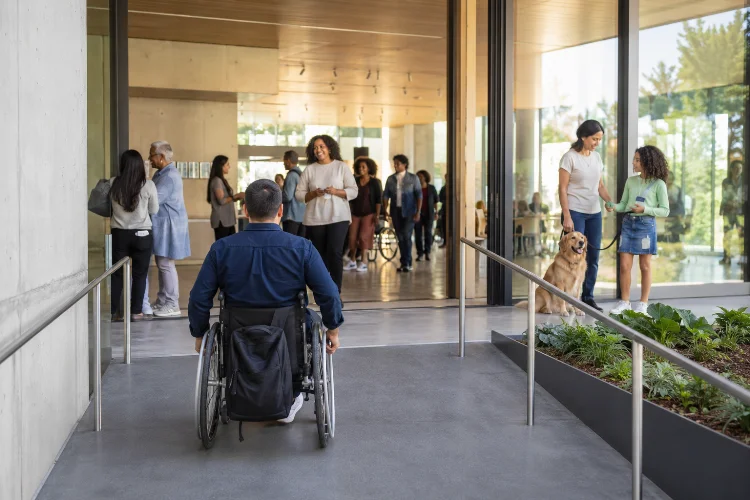
Imagine arriving at a community event and discovering that you cannot enter the building, understand the announcements, use the website, or participate in the activities
The event may technically be “open to everyone,” but that does not mean everyone can actually take part. This is why disability awareness matters.
Disability awareness means understanding that people experience disability in many different ways and recognizing how physical spaces, communication methods, technology, policies, and social attitudes can create barriers. Disability is also far more common than many people realize.
The World Health Organization estimates that around 1.3 billion people-about 16% of the global population-experience significant disability.
Understanding how disability awareness supports more inclusive communities shifts attention away from simply asking what a person cannot do. Instead, it encourages communities to ask what barriers can be removed so more people can participate independently, safely, and equally.
What Does Disability Awareness Really Mean?
Disability awareness is more than knowing that disabilities exist.
It involves understanding different accessibility needs, challenging inaccurate assumptions, communicating respectfully, and recognizing that many barriers come from environments rather than individuals.
The United Nations Convention on the Rights of Persons with Disabilities places dignity, autonomy, non-discrimination, accessibility, equality of opportunity, and full participation among its core principles.
Disabilities can also be visible or less obvious. Someone may use a wheelchair or white cane, while another person may have a hearing, cognitive, neurological, or other condition that is not immediately noticeable.
Awareness therefore discourages assumptions.
Instead of deciding what someone can or cannot do based on appearance, an inclusive approach allows people to explain what support or adjustments they actually need.
Inclusion Is About Removing Barriers
A powerful way to understand disability inclusion is to focus on barriers.
The CDC describes disability inclusion as removing barriers that interfere with full participation in society. These obstacles can include physical, communication, transportation, policy, and attitudinal barriers.
Consider a public library with stairs at the only entrance.
The problem is not simply that a wheelchair user cannot climb stairs. The building has been designed in a way that prevents some people from entering independently.
The same principle applies digitally.
A website without keyboard navigation may be difficult for some users with mobility disabilities. Videos without captions may exclude people who are deaf or hard of hearing. Important information provided only as complicated visual graphics may be inaccessible to other users.
Disability awareness makes these barriers easier to notice-and therefore easier to change.
Accessible Design Helps More Than One Group
Accessibility is sometimes treated as a special feature added only when a person with a disability requests it.
A better approach is to consider accesibility from the beginning.
The UN Convention specifically recognizes access to physical environments, transportation, information, communications technology, and public facilities and services as important for independent living and participation.
Many accessibility improvements also benefit people without disabilities.
A ramp can help wheelchair users, parents pushing strollers, workers moving equipment, and travelers carrying luggage. Captions can support people with hearing loss, language learners, and someone watching a video in a noisy room.
Clear signs and simple instructions can assist people with cognitive disabilities while making information easier for nearly everyone.
This is why inclusive design is often simply good design. It creates environments that work for a wider range of people instead of assuming everyone interacts with the world in exactly the same way.
Disability Awareness Challenges Stigma and Assumptions
Physical barriers are only part of the problem.
Attitudes can create barriers too.
The World Bank identifies stigma and discriminatory prejudice alongside inaccessible transportation, physical environments, communication systems, technologies, and services as obstacles to social and economic participation for people with disabilities.
Sometimes discrimination appears through openly negative behavior. In other situations, it comes from supposedly positive assumptions.
For example, someone may immediately start helping a wheelchair user without asking whether help is needed. Another person may speak to someone’s companion instead of communicating directly with the disabled person.
Good intentions do not automatically create respectful interactions.
A better habit is simple: communicate directly, avoid unnecessary assumptions, and ask before providing assistance.
Disability awareness encourages people to see individuals as people with preferences, skills, careers, relationships, ambitions, and personalities-not as conditions that need to be “fixed.”
Inclusive Schools Create Opportunities to Participate
Education is one of the most important places where inclusion begins.
An inclusive school does not simply enroll students with disabilities. It considers whether those students can participate fully in lessons, social activities, facilities, and the wider school community.
The UN Convention recognizes the right of persons with disabilities to inclusive education and calls for support that facilitates full and equal participation.
Practical inclusion might involve accessible classrooms, assistive technology, Braille, sign language, alternative communication methods, adapted teaching approaches, or additional support where necessary.
But attitudes matter just as much.
A student can have accessible learning materials and still feel excluded if classmates avoid them or teachers consistently underestimate their abilities.
UNESCO emphasizes that inclusive learning environments can help challenge discriminatory attitudes while creating welcoming communities and more inclusive societies.
When children experience inclusion early, respecting difference becomes part of ordinary community life rather than something unusual.
Workplaces Benefit From Disability Inclusion
Disability awareness also matters in employment.
A qualified employee should not lose opportunities simply because a workplace has inaccessible systems or because employers make assumptions about their capabilities.
The World Bank notes that people with disabilities continue to encounter barriers to employment and economic participation, alongside challenges involving education, transportation, technology, and access to services.
Workplace inclusion can involve practical changes such as accessible software, flexible communication methods, appropriate equipment, or modifications to physical environments.
It can also involve culture.
Managers can focus on what employees need to perform their jobs rather than assuming that disability automatically means lower capability. Colleagues can communicate normally rather than becoming uncomfortable or overly protective.
A more inclusive workplace creates room for people to contribute their expertise instead of wasting talent because systems were designed too narrowly.
Accessible Communication Makes Community Life Easier
A community can build an accessible entrance and still exclude people through poor communication.
Communication barriers affect people in different ways. The CDC notes that people with disabilities affecting hearing, speaking, reading, writing, or understanding may use different methods of communcation.
Accessibility can therefore include captions, sign-language interpretation, screen-reader-friendly documents, plain-language information, large print, audio formats, and alternative communication methods.
Imagine an emergency warning that is broadcast only as spoken audio.
Someone who is deaf may miss critical information.
Now imagine the warning is available through audio, captions, visual alerts, and accessible digital channels. The same message can reach a much wider audience.
Inclusive communication is not about creating completely different information for everyone. It is about giving people multiple reasonable ways to access the same essential message.
People With Disabilities Should Be Part of the Decisions
One of the most important principles of disability inclusion is participation.
Communities should not design policies, buildings, transportation, services, or programs for people with disabilities without listening to those who will actually use them.
The CDC specifically recommends including people with disabilities in program and structural design, implementation, monitoring, and evaluation.
Imagine a city redesigning its transportation system.
Engineers can understand technical requirements, but passengers with mobility, visual, hearing, or cognitive disabilities may identify practical problems that designers overlook.
Their lived experience is expertise.
Participation therefore improves more than representation. It can improve the quality of decisions.
The UN Convention similarly emphasizes full and effective participation and inclusion in society as a core principle.
An inclusive community does not merely speak about people with disabilities. It creates meaningful ways to make decisions with them.
Inclusion Supports Independent Community Life
A truly inclusive community allows people to participate in ordinary life with as much independence and choice as possible.
That can mean choosing where to live, accessing transportation, studying, working, shopping, meeting friends, attending cultural events, participating in sport, or using public services.
Article 19 of the UN Convention recognizes the equal right of persons with disabilities to live in the community and participate with choices equal to others.
This matters because inclusion is not simply about providing assistance.
Sometimes the most inclusive solution is designing systems so less assistance is necessary.
An accessible bus allows someone to travel independently. An accessible website lets a person complete a task without asking another person to do it for them.
Independence, dignity, and choice are closely connected.
How Everyday People Can Support Inclusion
Building inclusive communities is not only the responsibility of architects, governments, schools, or employers.
Everyday behavior matters too.
People can start by learning rather than assuming. Speak directly to people with disabilities, ask before helping, respect personal space and mobility equipment, and avoid treating disability as automatically tragic or inspirational.
Pay attention to your surroundings as well.
Can everyone enter the place where your group meets? Are online materials accessible? Could someone participate using a different communication method?
If you notice a barrier, mention it.
You do not need to understand every disability perfectly before supporting particiption. Awareness is partly about remaining willing to listen and adapt.
The goal is not to treat people with disabilities as special guests.
It is to build communities where participation feels ordinary.
Understanding how disability awareness supports more inclusive communities begins with recognizing that disability inclusion is about much more than kindness.
It involves accessibility, equal opportunity, respectful communication, independent participation, and removing barriers from schools, workplaces, transportation, technology, and public spaces.
Awareness also challenges stereotypes by encouraging people to listen to individuals rather than making assumptions about their abilities.
Most importantly, inclusive communities involve people with disabilities in the decisions that affect them. Look at one place you regularly use-a workplace, school, website, community center, or public event.
Ask yourself: Could people with different accessibility needs participate here independently and comfortably? If the answer reveals a barrier, that is a practical place to start making inclusion stronger.